






The first time you try to move serious water in a fire emergency is the worst possible time to learn your pump is undersized, hard to start or poorly matched to your tank and hose setup. A firefighting pump for rural property needs to do more than run on paper - it needs to start quickly, deliver usable pressure, and keep working when conditions are hot, dusty and urgent.
For rural blocks, lifestyle properties and working farms, pump selection is rarely just about litres per minute. You are balancing water source, suction lift, hose length, nozzle performance, fuel type, maintenance access and how the system will actually be used on the day. That is where many buyers get caught. A pump that looks powerful in a catalogue can still be the wrong fit if the application has not been thought through properly.
What a firefighting pump for rural property actually needs to do
On a rural property, a firefighting pump usually has two jobs. The first is asset protection - wetting down buildings, sheds, fence lines and surrounding ground before ember attack or flame front exposure. The second is active response - moving water to hoses, sprinklers or transfer lines when a spot fire starts or when a grass fire threatens infrastructure.
Those jobs sound similar, but they place different demands on the pump. If you are feeding a long hose run to a handheld nozzle, pressure matters. If you are filling a header tank or supplying multiple sprinklers, flow becomes just as important. In many cases you need both, which is why pump selection should focus on duty, not just a headline performance figure.
A common mistake is choosing solely on maximum litres per minute. High flow is useful, but not if the pressure drops away once hose length, elevation or nozzles are added. Another mistake is overbuying a large unit that is awkward to move, harder to prime and more expensive to maintain than the property really needs.
Water source matters more than many buyers expect
The best firefighting pump for rural property is always tied to the available water source. That might be a dedicated fire tank, dam, creek, rainwater storage or a combination of sources across the block. Each option changes the pump requirements.
A tank-fed setup is usually the most straightforward because suction conditions are predictable and water quality is cleaner. Dams and creeks are common on larger properties, but they introduce variables such as suction lift, debris, algae and seasonal water level changes. A pump that performs well from a full tank beside the house may struggle if it has to pull from a muddy dam edge with a longer suction line.
This is why suction performance is not a minor detail. Self-priming capability, correct suction hose sizing, foot valves, strainers and realistic lift expectations all affect whether water arrives at the nozzle when you need it. In bushfire planning, reliability at the source is as important as rated output.
Petrol, diesel or electric?
For most fire duty on rural properties, engine-driven pumps remain the practical choice. If mains power drops, an electric pump may be useless unless there is a properly designed backup supply. That makes petrol and diesel the usual options.
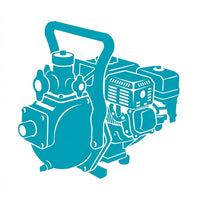
Petrol firefighting pumps are widely used because they are readily available, compact and often easier for homeowners to manage. They suit many domestic and light rural applications, especially where the pump needs to be portable and used intermittently. Diesel can make sense where longer run time, fuel storage strategy or fleet commonality matters, particularly on larger farms or commercial sites.
There is no single winner here. Petrol can be a sensible fit for many property owners, while diesel may be preferred for heavier-duty operation or where fuel handling practices already favour it. The key is not choosing by habit. Choose based on who will operate the pump, how often it will be tested, how it will be stored and whether the system needs to be mobile or fixed.
Pressure, flow and hose setup need to be matched
If your hose and nozzle arrangement is poorly matched, pump performance can be wasted. This is where practical design matters. A pump may produce strong flow at the outlet, but long hose runs, narrow hose diameter, poor fittings or elevation gain can reduce usable pressure significantly.
For example, defending a house pad from a nearby tank is a different task from reaching outbuildings, stock yards or boundary areas. The longer the hose run, the more friction loss you introduce. If the property has changes in elevation, the pump needs enough head to overcome that as well.
This is why one-size-fits-all recommendations are rarely useful. Some properties need a compact portable unit with good pressure for short, direct hose work. Others need a more capable pump to maintain output across longer distances or support multiple outlets. When buyers say a pump was "not powerful enough", the issue is often system design rather than pump quality alone.
Portability versus fixed protection
A portable unit gives flexibility. You can move it between tank points, load it on a ute or trailer, and deploy it where the risk is highest. That suits many landholders who need one machine to cover several jobs, including water transfer and washdown outside fire season.
A fixed setup has different advantages. It can be permanently connected to a dedicated tank, mounted under cover, and configured for faster startup with hard plumbing and clear operating instructions. For households with a bushfire plan, that simplicity can be valuable. Under pressure, fewer setup steps usually means a better outcome.
The trade-off is obvious. Portable pumps are versatile but may require more handling, hose management and priming. Fixed systems are faster to activate but less flexible if the fire threat shifts or if the property has multiple water points. Some rural owners solve this by combining a fixed protection system near key assets with a secondary portable pump for broader property use.
Reliability is not just about the pump itself
A firefighting pump for rural property is only as dependable as the full setup around it. Suction hose, delivery hose, couplings, strainers, valves and nozzles all need to be fit for purpose and easy to use. If one cheap component fails, the whole system fails.
Storage and maintenance matter just as much. An engine that has sat untouched for two summers with stale fuel is a risk. So is a suction hose with hidden damage, or a pump left exposed to weather and dust. Fire pumps should be tested under load, not just started briefly in the shed. You want to know the unit can actually draw water and deliver it through the intended hose run.
This is where specialist support has real value. A supplier that understands application matching, spare parts, servicing and troubleshooting can help avoid the common problems that only show up after purchase. Foundation Pumps works with buyers who need that kind of practical guidance, especially where the property setup is more complex than a standard off-the-shelf solution.
Features worth paying attention to
When comparing options, look beyond the badge and focus on serviceability and application fit. Engine quality, pump construction, priming performance and spare parts availability all matter in the real world.
It also helps to consider whether the unit will be used only for fire protection or across multiple jobs during the year. A pump that handles firefighting, tank transfer and washdown can be a good investment, but only if it still meets the pressure and flow demands of the fire application. Multipurpose use is useful. It should not compromise the main reason you bought it.
If you are comparing trusted brands, think about local support as well as specifications. Access to parts, service and technical advice is worth more than a marginal paper advantage that becomes a headache later.
When bigger is not better
There is a natural tendency to think the largest firefighting pump available is the safest option. Sometimes it is. Often it is not. Bigger pumps can be heavier, noisier, thirstier and harder to manage. They may also encourage a false sense of security if the rest of the system has not been designed to suit.
A correctly matched pump with reliable starting, sensible hose sizing and a proven water source will usually outperform an oversized setup that is difficult to operate. For rural property owners, practical performance beats theoretical maximums every time.
The right choice comes from understanding how the property is laid out, what needs protection first, where water is stored, and who will be using the equipment in a stressful situation. If those questions are answered properly, the pump selection becomes much clearer.
If you are buying for bushfire preparedness, think less about owning the biggest machine and more about owning a system you can trust, test and operate without second-guessing. That is usually the difference between a pump you have on site and a pump that is genuinely ready when conditions turn bad.