



A paddock trough that runs dry in the middle of summer is not a minor inconvenience. It affects stock health, grazing rotation and daily labour straight away. That is why choosing the right solar water pump for livestock is less about chasing a trend and more about building a water supply system that keeps working when conditions are harsh and power is limited.
For many Australian properties, solar pumping makes practical sense. It suits remote troughs, bores and tanks where running mains power is expensive or simply not an option. It can also reduce generator use and ongoing energy costs. But a solar setup only performs well when the pump, solar array, controller, pipework and storage are matched to the job.
Why a solar water pump for livestock suits many farms
Livestock watering is usually a steady, predictable application. Cattle, sheep and goats need reliable daily volumes, and most farms already use troughs and storage tanks to manage supply across multiple paddocks. That makes solar a strong fit because the system can pump gradually through daylight hours and refill storage without constant supervision.
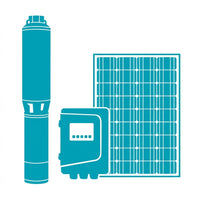
The main advantage is independence. A well-designed solar pumping system can operate in remote parts of a property without trenching power over long distances. That can make upgrades more affordable, especially where terrain, distance or existing infrastructure turn conventional power into a major cost.
There is also a maintenance and operating cost benefit. Solar pumping systems can be straightforward, but only if they are designed properly. A cheap undersized setup often creates more call-outs than it saves. The better approach is to treat it like any other farm water system - start with the duty, calculate the requirement, then select components that can handle real conditions.
Start with the water requirement, not the panel size
The most common mistake is choosing a pump by wattage alone. What matters first is how much water needs to move each day, how far it has to travel and how high it must be lifted.
A solar water pump for livestock should be sized around three core figures: daily water demand, total head and available solar window. Daily demand depends on stock numbers, class of animal and seasonal conditions. A mob of cattle in hot weather will place a very different load on the system compared with sheep in milder conditions.
Total head is where many systems come unstuck. It is not just bore depth. You need to account for static lift, drawdown, elevation gain to the tank, pressure requirements if relevant, and friction losses through pipework. A pump that looks adequate on paper can fall short once the full head is calculated.
Then there is the pumping window. Solar systems generally do their best work across the middle of the day, but cloud cover, winter sun angle and panel orientation all affect output. If the site only gets a limited effective pumping period, the system needs to move enough water within that window or rely on larger storage.
Solar water pump for livestock: bore, dam or tank?
The water source influences the pump type as much as the livestock demand does. There is no one-size-fits-all option.
For bores, a solar bore pump is often the right choice. These are designed to work at depth and can be very effective where the bore yield is suitable and the water quality is within the pump’s operating range. Bore depth, standing water level and drawdown need to be confirmed before selecting the pump.
For dams, creeks or shallow ground tanks, a surface-mounted transfer pump may be appropriate, provided suction conditions are realistic. In some cases, a submersible pump placed near the source is the better option because it avoids suction limitations and improves reliability.
For tank-to-trough transfer, the duty may be simpler, but pipe run and pressure drop still matter. If the system needs to serve several troughs across a long distance, the pipe design should be checked alongside the pump selection.
Storage is what makes the system reliable
If there is one design principle that consistently improves livestock solar pumping, it is adequate storage. Solar power is variable. Livestock demand is not always variable in a helpful way. When several hot days arrive together, consumption rises at the same time weather conditions can challenge system performance.
That is why many reliable farm systems pump to a header tank or storage tank first, then gravity-feed or transfer water to troughs. Storage acts as a buffer. It reduces pressure on the pump, gives you reserve during poor weather, and buys time if a component needs service.
Trying to run a solar setup as a direct, just-in-time supply to stock is possible in some situations, but it leaves less margin for error. On remote or larger properties, storage is usually the safer call.
What affects performance in the real world
Solar pumping figures can look tidy in a brochure. The paddock is less forgiving. Dust on panels, shading from trees, long cable runs, poor orientation and extreme heat all affect output. Water quality also matters. Sand, iron, sediment and salinity can shorten pump life or reduce efficiency if the equipment is not selected for the conditions.
Pipe size is another overlooked factor. Undersized pipe increases friction loss, which means the pump works harder to deliver less water. Spending a bit more on proper pipe sizing can improve system performance and reduce stress on the pump over time.
Seasonality should also be considered from the start. If the system only just meets demand in ideal summer conditions, it may struggle through winter or extended cloudy periods. That does not always mean oversizing everything. Sometimes the better solution is a balance of pump capacity, solar array size and tank storage.
Choosing components that suit farm conditions
A dependable system is not just about the pump itself. The controller, solar panels, mounting frame, float switches, dry-run protection and pipework all play a part in long-term reliability.
Controllers matter because they manage pump performance against changing solar input. Protection features are worth having, particularly for bores or low-yield sources where dry running can damage equipment. Float control at the storage tank helps automate operation and avoid overflow.
Mounting also deserves attention. Panels need to be secure, positioned for good sun exposure and installed to handle local wind conditions. In exposed rural areas, a weak frame can become an expensive problem quickly.
If theft or vandalism is a concern, system layout and physical protection should be discussed upfront. That is not a pumping issue in the strictest sense, but it affects system resilience just the same.
When a solar water pump for livestock may not be the best fit
Solar is a strong option, but it is not always the right one. If the site has very high daily demand, poor solar access, complex pressure requirements or critical around-the-clock delivery with minimal storage, another setup may be more suitable.
Some properties are better served by a conventional bore pump with mains power, or a hybrid arrangement that combines solar with backup generation or battery support. In other cases, the water source itself is the limitation rather than the power supply. If the bore yield is low or variable, changing the pump will not solve the underlying constraint.
That is where application-based advice matters. The right system depends on source, distance, elevation, demand pattern and how much operational margin the property needs.
A practical way to size the system
Before choosing equipment, gather the basic operating data. Confirm the water source, expected daily demand, pipe length, elevation changes and tank arrangement. If it is a bore application, measure standing water level, pump setting depth and expected drawdown if possible.
From there, the system can be matched to the duty rather than guessed. That usually leads to better pump selection, more realistic solar array sizing and fewer surprises after installation. For farms running multiple paddocks or staged watering points, it may also show that splitting the job across zones is more efficient than trying to do everything with one oversized setup.
A specialist supplier with both product range and technical support can help sort through those variables before money is spent in the wrong place. For buyers who want a system that works beyond the first season, that step is worth taking.
The best livestock water systems are rarely the flashiest. They are the ones that keep delivering clean water, day after day, with enough margin to handle heat, distance and the occasional problem. If you are planning a solar pumping setup, start with the application, be realistic about the conditions, and give storage the attention it deserves.