



A pump can deliver plenty of water at ground level yet leave a two-storey home, stock trough line or washdown point short on pressure. That is where the centrifugal pump vs multistage question matters. The right choice is not simply the pump with the bigger motor. It comes down to the flow you need, the pressure or head the system must overcome, the water quality and how the pump will operate over time.
The terminology can also cause confusion. A multistage pump is a type of centrifugal pump. In most practical discussions, the comparison is between a conventional single-stage centrifugal pump and a multistage centrifugal pump. Both use a spinning impeller to move water, but they build pressure in different ways and suit different duties.
Centrifugal pump vs multistage: the core difference
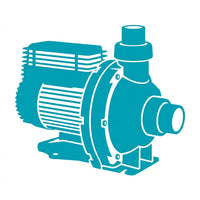
A single-stage centrifugal pump has one impeller. Water enters at the impeller eye, is accelerated outward by centrifugal force and leaves the casing at a higher velocity and pressure. This simple arrangement is widely used for transfer, irrigation, drainage, tank filling, firefighting and general water movement.
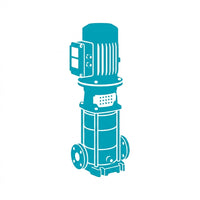
A multistage pump uses two or more impellers arranged in series. Water passes from one stage to the next, with each impeller adding more energy. Rather than relying on one large pressure increase, the pump builds total head progressively across several stages.
In practical terms, a single-stage centrifugal pump is generally selected for higher flow at low to moderate head. A multistage pump is generally selected when a system needs higher pressure, particularly where the required flow is moderate rather than extreme. There are exceptions: impeller diameter, speed, casing design and motor size all affect the final duty. Always read the pump curve rather than choosing on the number of stages alone.
Start with flow and total head
Pump selection begins with the duty point. This is the flow rate required at the total head your system creates.
Flow is usually measured in litres per minute or litres per second. It answers the question, “How much water needs to move?” A garden irrigation system may require enough flow to run several zones, while a transfer application may only need to fill a tank within an acceptable time.
Head is the total resistance the pump must overcome, measured in metres. It includes vertical lift, required outlet pressure, friction through pipework and fittings, filters, valves and any elevation change after the pump. As a rough water-pressure guide, 10 metres of head is close to 100 kPa, but selection should be based on the complete system calculation rather than this shortcut.
For example, a pump supplying a tank 12 metres above the water source may also need to deliver 250 kPa at a pressure washer connection. Add pipe losses through long irrigation lines, filters and valves, and the duty can quickly exceed what a standard transfer pump performs efficiently. A multistage pressure pump may be the better fit.
Conversely, moving large volumes from a dam to a nearby storage tank may need only modest head. A single-stage centrifugal transfer pump can often provide the required flow with a simpler arrangement and lower initial cost.
Where a single-stage centrifugal pump performs well
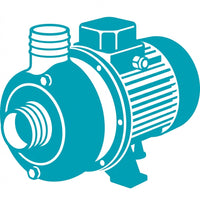
Single-stage centrifugal pumps are common because they are straightforward, adaptable and available in many configurations. End-suction pumps are a familiar example in agricultural, commercial and industrial installations. Depending on the model, they can handle clean water, lightly contaminated water or particular chemical and process fluids.
They are often a sound choice for water transfer, irrigation supply, tank-to-tank pumping, cooling-water circulation, low-head boosting and some firefighting duties. For high-flow applications, a single larger impeller can move substantial water volumes without the internal complexity of multiple stages.
Their limits appear when pressure requirements rise. A single-stage pump can be built for higher head, but it may need greater speed or a different impeller arrangement. Running far from its best efficiency point can increase power use, vibration, heat and wear. A pump that looks capable by its maximum-head figure may still fall short at the flow rate the application actually requires.
Where multistage pumps are the better choice
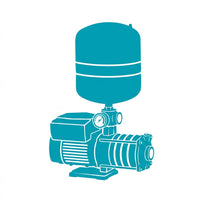
Multistage pumps are designed for pressure. Horizontal multistage pumps are commonly used for domestic pressure systems, rainwater supply, light commercial boosting and irrigation where pressure at the outlet matters. Vertical multistage pumps are frequently used in commercial buildings, water treatment, process systems, boiler feed, high-pressure washdown and larger boosting systems.
Their staged design can provide strong pressure while maintaining useful flow. This makes them suitable where water must travel uphill, across long pipe runs or through equipment that creates resistance. A bore application may also call for a multistage design, although submersible bore pumps, surface-mounted multistage pumps and pressure systems each have different installation requirements.
Multistage pumps can offer good efficiency at a defined high-head duty, especially when correctly matched to the system curve. They are not automatically more efficient in every application. If the duty is low head and high flow, a multistage unit can be unnecessarily expensive and may operate poorly if throttled back heavily.
Pressure is not the only consideration
A pump curve shows how flow changes as head changes. At zero flow, the pump reaches its shut-off head. As flow rises, available head falls. The system curve works in the opposite direction: greater flow increases friction losses. Where the two curves meet is the operating point.
This is why maximum flow and maximum head figures should never be treated as a combined performance claim. A pump may be rated at 120 litres per minute at very low head and 60 metres maximum head at no flow. Neither number tells you what it delivers at 35 metres head.
The best selection places the expected operating point close to the pump's best efficiency point, with sensible allowance for variations in water level, dirty filters, pipe ageing and future demand. For irrigation, consider whether zones will run independently or together. For a pressure system, consider cut-in and cut-out settings, draw-off pattern and whether variable-speed control is needed.
Installation factors that can change the answer
Suction conditions are critical for both pump types. Surface pumps do not pull water indefinitely. Atmospheric pressure, suction lift, pipe friction, water temperature and vapour pressure all affect whether water reaches the impeller without cavitation. Cavitation occurs when vapour bubbles form and collapse inside the pump, causing noise, loss of performance and possible impeller damage.
Keep suction pipework short, correctly sized and airtight. Avoid unnecessary elbows and restrictions before the pump. A foot valve or non-return valve must suit the application and remain serviceable. If the water level is deep or variable, a submersible pump may be more suitable than asking a surface-mounted centrifugal pump to work beyond its practical suction capability.
Water quality matters as well. Many multistage pressure pumps are intended for clean water. Sand, abrasive sediment or stringy debris can damage impellers, seals and diffusers. A screened intake, suitable filtration or a pump designed for solids handling may be required. Do not assume a stainless-steel body means the pump is suitable for abrasive water or every chemical.
Electrical supply and control also deserve attention. A pressure switch and pressure tank can suit a basic domestic system, while a variable-speed controller may provide steadier pressure and reduce cycling for variable demand. Larger multistage systems may need dry-run protection, phase protection, level controls or duty-standby arrangements to avoid costly downtime.
Comparing cost, servicing and operating life
A single-stage centrifugal pump is often simpler to inspect and repair. Parts such as mechanical seals, impellers, O-rings and bearings still wear, but there are fewer hydraulic stages to assemble and maintain. For straightforward transfer duties, this can make it a practical long-term option.
Multistage pumps contain more impellers, diffusers and seals, so servicing can be more involved. In return, they can solve high-pressure duties that a single-stage design cannot meet efficiently. The better value is the pump that matches the duty and remains within its intended operating range, not necessarily the unit with the lowest purchase price.
Pay particular attention to cycling. A pump that starts every time a small tap opens may have an undersized pressure tank, a leak, poor control settings or a duty mismatch. Frequent starts place stress on motors, capacitors, switches and seals. Correctly sizing the pressure vessel and controls can extend service life on either pump type.
A practical way to choose the right pump
Before selecting a pump, record the source water level, vertical lift, pipe size and length, required flow, desired outlet pressure, water quality and available power supply. Include every filter, valve, sprinkler, fitting and elevation change that adds resistance. If the system will expand later, allow for that in the duty rather than oversizing blindly.
Choose a single-stage centrifugal pump when the work is primarily high-volume transfer or low-to-moderate head circulation. Choose a multistage pump when the application requires sustained pressure, higher head, long pipe runs or boosted supply to several outlets. For a critical commercial, farm or industrial system, have the duty checked against the manufacturer’s curve before installation.
Foundation Pumps can help assess the application, not just the pump category. A clear duty calculation and the right controls will do more for reliable water supply than extra motor power ever will.